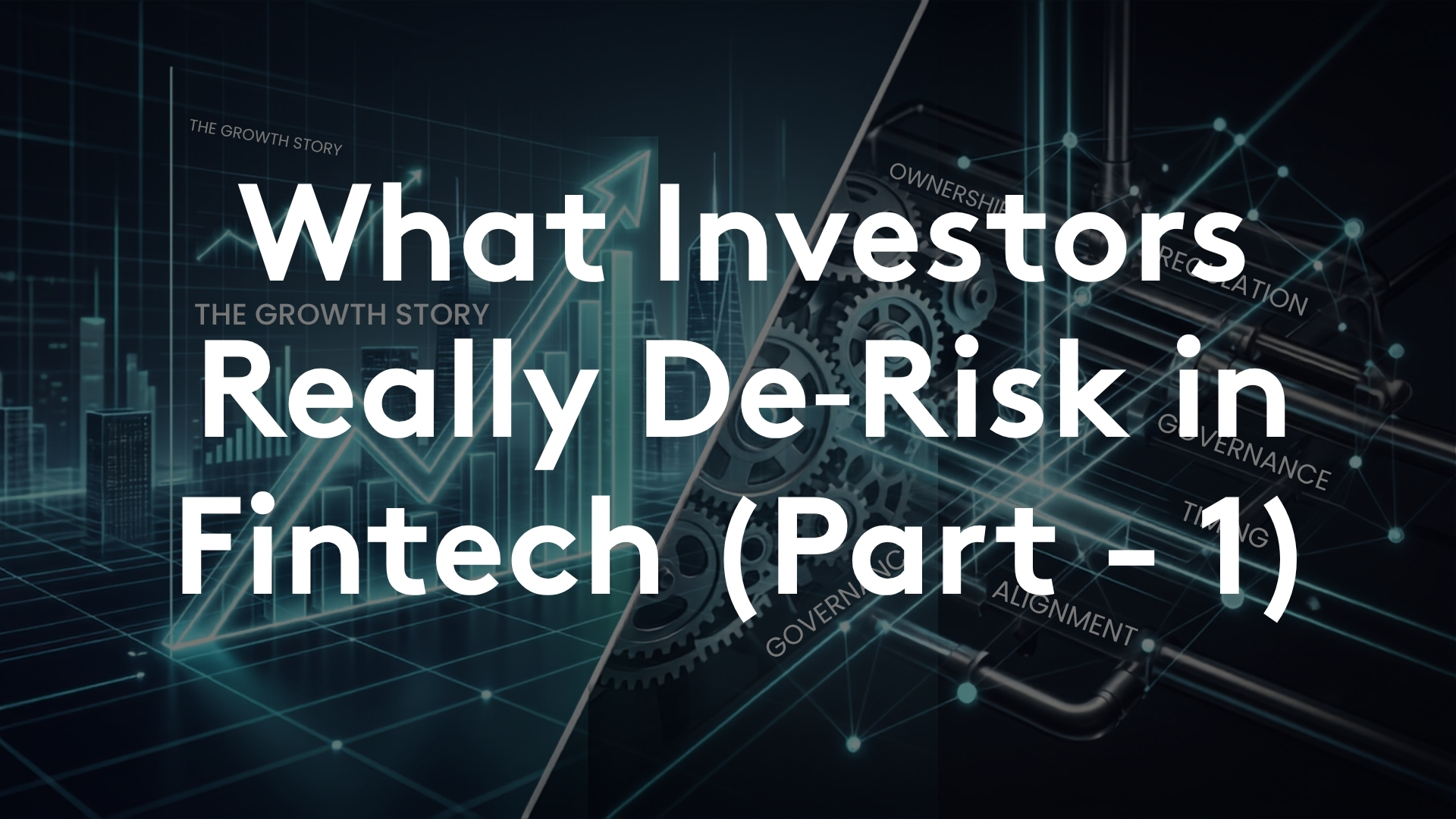
Evaluating risk is what I do for a living: regulation, ownership, governance, alignment, and timing. The discipline of evaluating risk in a business generating hundreds of millions in revenue carries over to a fintech startup.
The biggest difference is structural: a large company runs several revenue streams, so a problem in one can be cushioned by the others. A startup usually has one or two. The same risk that is a footnote in a diversified business can be fatal in a young one. That is exactly why investors look at early-stage companies in depth. Across the deals I assess and the founders and investors I’ve advised over the past five years, the same five risks come up every time. Yet, most founders prepare for none of them.
This article shares how investors really think about risk when they look at fintech and tech-enabled companies, broken down into practical buckets such as regulation, ownership, governance, alignment, and timing, drawn from how risk gets assessed across regulated, tech-enabled businesses.
The real deal-killers are usually hidden in less visible areas: who actually owns the company, the founder’s background, how decisions get made, how exposed the business is to regulation, how much market share the business holds in the field, where the business’s growth is heading, whether the timing works for both sides, or simply where the industry is heading.
The same gap shows up again and again. Founders walk into a raise braced for a fight over valuation. They build the model to defend the number, rehearse the growth story, and wait for the pushback on price. But the pushback rarely starts there. By the time an investor is negotiating valuation, they have usually already decided they want the deal. The harder question – the one that quietly kills more transactions than price ever does – gets asked much earlier, and out of the founder’s earshot: is this company safe to back?
Investors buy into a founder’s growth story. They don’t just buy it at face value. They stress test everything, particularly for early-stage startups – every number, every assumption about the market, every claim about what happens next.
The five risks below are the lenses investors iron through. Each one that looks unresolved makes the growth story less trustworthy, and a less trustworthy story is worth less. That is the real mechanic behind valuation: not the number a Founder puts forward, but how much of the company investors believe.
Risk 1: Regulation: where the business sits relative to the industry
For anything fintech or tech-enabled, the regulatory question comes fast. Is the fintech licensed, do they need to be, and if a licence takes long enough to get, will the delay cost the business its edge? Are they operating in a grey area that is about to get coloured in? Regulation is rarely a clean yes or no.
More often a company is running on an interpretation that has not been tested or relying on a partner’s licence in a way that could unwind. Investors are not looking for them to have solved this. They are looking for evidence that they understand exactly where they sit relative to the industry and have a credible read on where the perimeter is moving. Founders who wave the question away worry the investor more than founders who name the risk plainly.
Risk 2: Ownership: who actually controls the company
Once investors are interested in the business and the industry, they want to understand who really holds the company, and the org chart does not answer that. The cap table does. A complex one is a red flag out of proportion to its size: an early advisor sitting on 8% for earlier work, a departed co-founder still holding equity, a stack of SAFEs nobody has modelled through to conversion.
None of these are fatal on their own. Together they tell an investor that control is uncertain, and uncertain control means a harder time getting decisions made later. When ownership looks complex and unresolved, the assumption is that the company is harder to govern than it appears.
Risk 3: Governance: how decisions get made, and what happens if a key person leaves
Next is how the company operates. Who signs off on what, how the board functions, and the question founders hate most: what happens if the key person walks. In many early companies, that key person is the Founder, and the honest answer is that the company stops. That is key-person risk, and it is one of the most underrated deal-killers there is.
Most committees will not approve a company that cannot survive losing one person. So if nothing moves without the key member of the founding team, that dependence is the risk — and the investor is the one being asked to carry it.
Risk 4: Alignment: do founders and investors want the same outcome
This one surfaces late and can kill deals: whether the Founder and the investor actually want the same outcome on the same horizon. The Founder might be building something that intends to run for fifteen years. An investor might need an exit inside seven. Both positions are reasonable.
Together in one deal these are slow-motion problems that show up at the worst possible time, usually when the next round or a sale is on the table. Getting alignment explicit early is uncomfortable. But it is far cheaper than discovering the gap after the money is in.
Risk 5: Timing: right for both sides, not just for the Founder or Investor
Timing cuts two ways. There is the Founder’s moment, whether the market is ready for what the Founder is building, and there is the investor’s moment, whether this fits what their fund needs to be doing right now.
A fund near the end of its cycle, or one that has already filled its allocation in the Founder’s startup category, can love the Founder’s company and still pass. That is rarely about the Founder or the business. It is worth understanding before the Founder spends three months on a process that was never going to clear on the other side’s calendar. Timing is a wild card.
The deals that close cleanly are the ones where this was sorted before anyone opened a model. The ones that drag, or quietly die, are the ones where a Founder spent all their preparation on the story and none on the plumbing.
Getting Founders ready for that scrutiny is exactly what Fintech Circle’s board programme is built around. In Part 2, I will turn these five risks into a checklist Founders can work through before they start raising, so the questions an investor asks in private are ones they should have already answered.
The views expressed are the author’s own and drawn from general professional experience. They do not represent any current or former employer, and no confidential or client-specific information is referenced.
About the Author
Michelle Luan
Michelle Luan is an Investment Banking Associate in M&A investment banking, specialising in risk evaluation across technology-enabled businesses. She works with founders to refine strategy, prepare for fundraising, and de-risk their path to capital. She has advised on large capital raises and M&A transactions (c. $500m–$5bn) for companies operating in areas such as fintech infrastructure, digital platforms, data-driven mobility, and other technology-led businesses.
The views expressed are the author’s own and drawn from general professional experience. They do not represent any current or former employer, and no confidential or client-specific information is referenced.
About MHA
MHA is the UK member firm of Baker Tilly, a global network of accounting and consulting firms providing expert advice across tax planning, assurance, corporate finance and audit. We work with scaling-up Fintechs and established national and global financial services businesses, providing the same level of care and attention to all clients.