
Key Tax & Regulatory Insights from BDO Supporting the UK Fintech Sector
Date: November 25 2025
Author: FINTECH Circle
Q1: What are the biggest tax issues early-stage Fintechs face, and where does BDO add the most value?
Fintechs move through distinct tax challenges as they scale, but several issues consistently surface early:
1. Getting the corporate structure right
A well-designed structure prevents unnecessary tax leakage and creates flexibility for future investment, global expansion and potential exits. Early fixes are far simpler than retrofitting a structure once operations and investors are already in place.
2. Securing tax reliefs
Innovation incentives can materially extend a fintech’s runway:
- R&D tax credits provide essential funding that directly supports product development.
- If aspects of the technology can be patented, Patent Box can reduce the corporation tax rate on relevant profits to around 10%, delivering significant long term savings.
BDO’s specialists help identify qualifying activities, prepare robust claims and minimise the likelihood of HMRC scrutiny.
3. Financing decisions with tax impact
Choosing between debt and equity has long-term consequences for tax treatment, investor expectations and operational flexibility. Schemes such as EIS and SEIS are often critical to attracting early investors but require careful planning to ensure compliance.
4. VAT complexity and managing irrecoverable VAT
Fintechs often operate with partial exemption, meaning VAT becomes a real cost. BDO helps:
- Identify ways to minimise irrecoverable VAT within the existing legislative framework
- Manage reverse charge VAT for overseas purchases
- Correct late registrations or under-declarations and work with HMRC on penalty mitigation
5. Transfer pricing as Fintechs internationalise
Intercompany arrangements — IP licensing, shared services, funding flows — become increasingly important as Fintechs expand. Early-stage companies sometimes overlook transfer pricing, but regulators now scrutinise Fintechs because of their intangible-rich business models.
BDO supports Fintechs by designing compliant and commercially practical transfer pricing policies and documentation to reduce audit risk.
Where BDO Adds Value
Tax-Efficient Structuring
- Designing flexible group structures that minimise tax exposure
- Advising on jurisdiction choices for international expansion
- Ensuring the structure aligns with regulatory obligations
Unlocking Reliefs
- Identifying and preparing R&D and Patent Box claims in the UK and internationally
- Producing robust evidence to support claims
Financing Strategy
- Advising on tax implications of debt vs equity
- Supporting investor incentive schemes (EIS/SEIS)
VAT & Transfer Pricing
- Reducing irrecoverable VAT where possible
- Ensuring reverse charge compliance
- Creating and documenting scalable transfer pricing models
Q2: How can BDO support Fintechs in building the right team early?
Attracting and retaining talent is one of the most important early-stage priorities. Tax plays a significant role, especially around:
- Equity, options and other employee incentives
- Bonus structures
- Tax implications of benefits, particularly following recent budget changes
BDO helps Fintechs design efficient, attractive reward structures aligned with both employee expectations and regulatory requirements.
Training, Readiness and Practical Support
Fintech teams scale quickly, so early education helps avoid costly mistakes. BDO offers:
- Training on key tax and regulatory topics
- Workshops and roundtables with industry peers
- Support with pitch readiness for fundraising, and IPO readiness for later-stage companies
- Outsourcing to support lean teams
Many Fintechs begin with small finance teams. BDO’s outsourcing services act as a flexible back office, covering:
- Accounting records
- Monthly management accounts
- Quarterly VAT returns
- Year-end financial statements
- Tax computations and filings
- Company secretarial services (excluding Registered Office)
BDO can also support the three-lines-of-defence model by providing outsourced Risk, Compliance and Internal Audit services — an approach that aligns with FCA expectations and helps Fintechs demonstrate sound governance from an early stage.
Q3: What are the biggest regulatory challenges faced by Fintechs?
The UK’s regulatory framework aims to promote trust and resilience while supporting innovation. Fintechs must address several core expectations from the FCA:
1. Safeguarding customer money
This remains the regulator’s top priority. Fintechs must demonstrate strong governance, clear oversight, robust systems and well-maintained records.
2. Promoting competition and innovation
Firms need to evidence that their products deliver good outcomes and reflect user needs and characteristics.
3. Preventing financial crime
The FCA expects firms to take proactive steps in identifying, preventing and reporting financial crime risks.
4. Strengthening operational resilience
Operational failures — cyberattacks, IT outages, third-party disruption — can cause significant consumer harm. Fintechs must build resilient operations that can withstand and recover from disruption.
Understanding the principles-based nature of the UK regime is essential. BDO helps Fintechs navigate these nuances and implement frameworks that can scale as the business matures.
Q4: What tax issues should Fintechs consider when expanding internationally or outsourcing development?
Expansion and outsourcing introduce several tax considerations:
1. Internationally mobile employees
Fintechs must determine whether employee activity abroad creates a taxable presence, permanent establishment risks or employer reporting obligations.
2. Choosing the right expansion vehicle
Whether to operate through foreign branches or local subsidiaries depends on commercial strategy, tax treatment and regulatory requirements.
3. Selecting suitable territories
Some jurisdictions offer incentives for innovation, holding companies or IP ownership. Understanding these upfront can reduce long-term tax leakage.
4. Mitigating withholding tax
Cross-border payments may attract withholding tax unless mitigated by treaties, structuring or appropriate legal agreements.
5. Locating intellectual property
Where IP sits affects tax, transfer pricing and legal protection. BDO helps Fintechs evaluate options based on their operating model and long-term goals.
6. Designing intercompany arrangements
Shared services, cost-sharing, funding flows and IP licensing all require appropriate pricing and documentation.
Regulatory considerations
When expanding abroad, Fintechs must also assess:
- What is regulated in each jurisdiction
- How multi-territory payment chains impact fraud detection
- Variations in global regulatory standards
- Data protection laws affecting cross-border data flows
- Cultural and operational differences that affect delivery
BDO works with its international network to provide tax, audit, regulatory and advisory support in each jurisdiction, ensuring consistency while addressing local nuance.
Q5: To conclude, what does BDO offer fintech startups and scaleups?
BDO’s fintech team brings together specialists from professional services, regulators and industry, including individuals who previously worked inside major financial institutions. This depth of experience enables BDO to understand the full financial services ecosystem and the realities of scaling regulated businesses.
An integrated approach
BDO offers a single, coordinated service across:
- Tax
- Advisory
- Regulatory
- Audit
- Accounting and reporting
- Outsourcing
- Growth advisory
- M&A
Fintechs benefit from holistic advice that avoids unintended consequences — for example, preventing a tax-efficient structure from creating regulatory problems.
Each client works with a central relationship manager who draws in the right specialists as needed, allowing Fintechs to build capabilities at the right pace.
Tax expertise
BDO provides comprehensive support across corporate tax, indirect tax, employment tax, R&D, transfer pricing, tax technology, tax risk management and personal tax for founders and investors. The team works collaboratively with tax authorities and is focused on improving clients’ tax and commercial positions through proactive planning.
Regulatory and advisory support
BDO’s advisory specialists are deeply involved in current regulatory developments and provide services across:
- Safeguarding
- Operational resilience
- Economic crime
- Governance and oversight
- Third-party assurance
- Internal audit
Audit and reporting
BDO has extensive experience auditing Fintechs across payments, digital banking, alternative finance and cryptoasset businesses, as well as supporting technical accounting under IFRS and UK GAAP.
Outsourcing and operational support
BDO’s outsourcing team handles bookkeeping, statutory accounts, regulatory returns and back-office finance functions, allowing Fintechs to focus on growth.
Growth and M&A
BDO supports Fintechs throughout the funding lifecycle:
- Positioning the business to attract funders
- Developing raise strategies (debt, equity, valuation, tranching)
- Preparing for due diligence
- Connecting with suitable investors
BDO’s fintech M&A team guides both buy- and sell-side transactions and conducts due diligence.
As the UK’s fifth-largest accountancy firm — and part of the world’s fifth-largest global network — BDO provides the reach, expertise and local insight Fintechs need as they grow from startup to international scale.
To explore BDO’s latest insights, including their post-Budget analysis, join our upcoming webinar “Fintech & the UK Autumn Budget” on 9 December here.
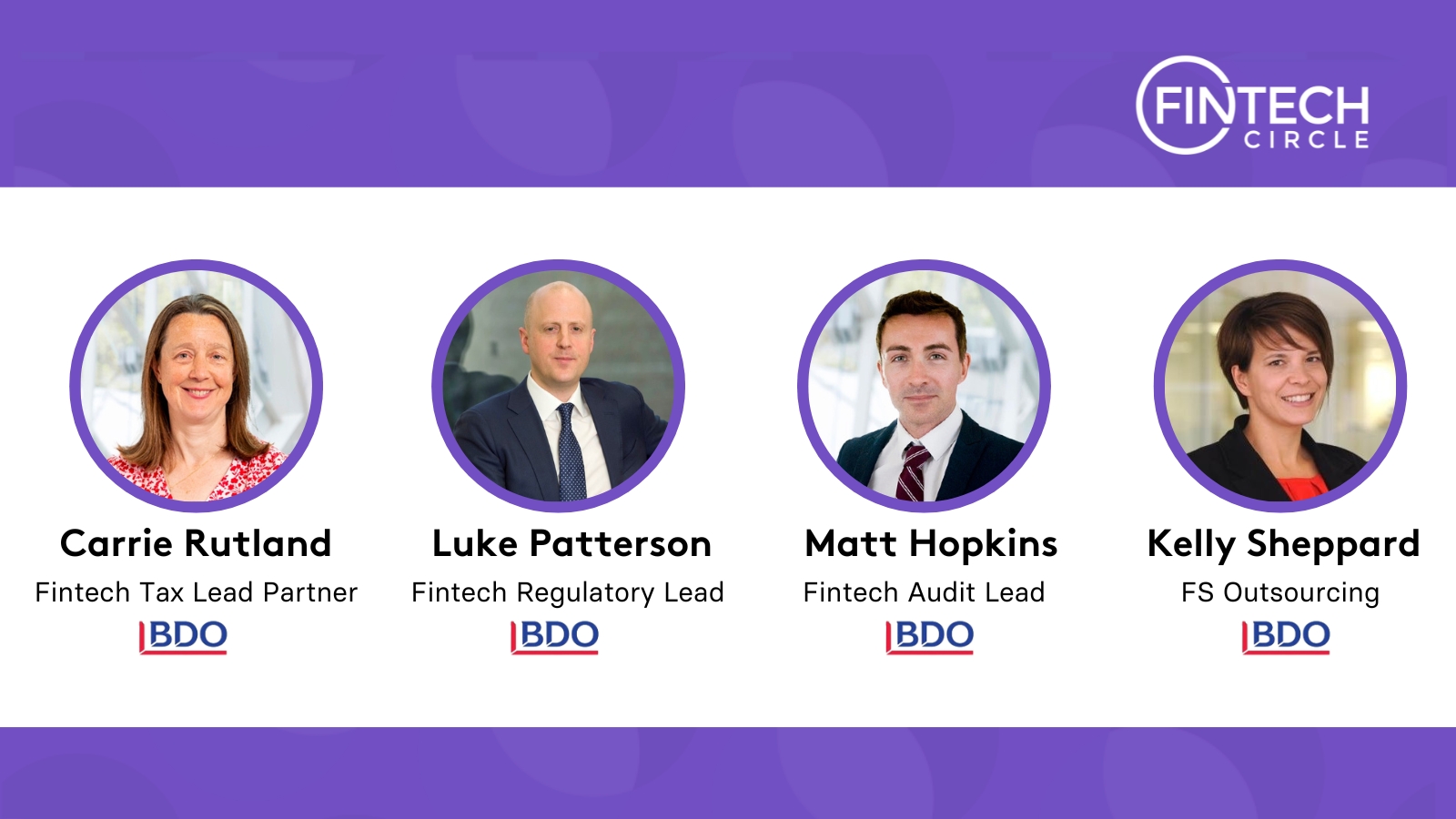
Carrie Rutland – Fintech Tax Lead Partner, BDO
Carrie is the Fintech Tax Lead Partner at BDO. As such, she coordinates with her fellow tax colleagues to bring the best of BDO to Fintechs from early stage to IPO. Her personal specialism is R&D tax credits and patent box.
Carrie spent 15 years working in the Financial Services sector – so has direct industry experience. She is also an FCA and prize winning CTA.

Luke Patterson – Fintech Regulatory Lead, BDO
I have been working with Financial Services industry clients for more than 20 years on national and global projects for Payment Services, Insurance and Pension related organisations, predominately in the private sector.
I am a Fellow of the Chartered Institute of Accountants of England and Wales, a member of the Chartered Institute of Insurance and has spent two years as president of his local insurance chapter. I focus on growing BDO’s presence in the Payment Services and Insurance sectors. I currently act as Head of Internal Audit for a large pension scheme, an insurance company and supports clients on a co-sourced basis within the Payment Services sector.

Matt Hopkins – Fintech Audit Lead, BDO
Matt is an audit partner in our Banking & Alternative Finance team. He leads a number of UK and international audit engagements with a particular focus on digital and challenger banks. He has many years of experience in auditing banks and other financial services businesses – challenger and incumbent.
He has had significant exposure and experience of the UK Fintech market and as a member of our Global Financial Services group is active in the provision of innovation and audit quality for cross-border digital financial services.

Kelly Sheppard – FS Outsourcing, BDO
Kelly is a partner and acts for a number of financial services groups including private equity firms, consumer credit firms, asset managers, fund managers, brokers and corporate finance advisers. Her clients include international entities and listed groups.
Kelly provides a range of services, including audit, compliance, accounting, financial services compliance and general ad hoc advisory requirements to a variety of clients including those with international operations. She has advised on and ensured clients comply with both UK and International Financial Reporting Standards.